
The Birman cat has a soft, flowing coat, deep blue eyes, dark markings on the face and legs, and white paws. Many people also know it as the Sacred Birman cat. It is usually friendly and easy-going, enjoys playing and spending time with its family.
At Cat House, learn about the Birman cat breed’s appearance, colors, patterns, personality, temperament, size, lifespan, grooming, health, kittens, price, breeders, adoption, and care.
Shop the collection

Birman Cat Appearance
The Birman cat breed has a medium to large body with a sturdy, well-proportioned build. Its coat is medium to long, soft, and silky.
One of the most recognisable Birman cat characteristics is its colorpoint appearance. The body is lighter, while the face, ears, legs, and tail have darker coloring.
Birman cats also have striking blue eyes and white paws that look like small “gloves.” Together, these features give the breed its distinctive appearance.
Birman Cat colors
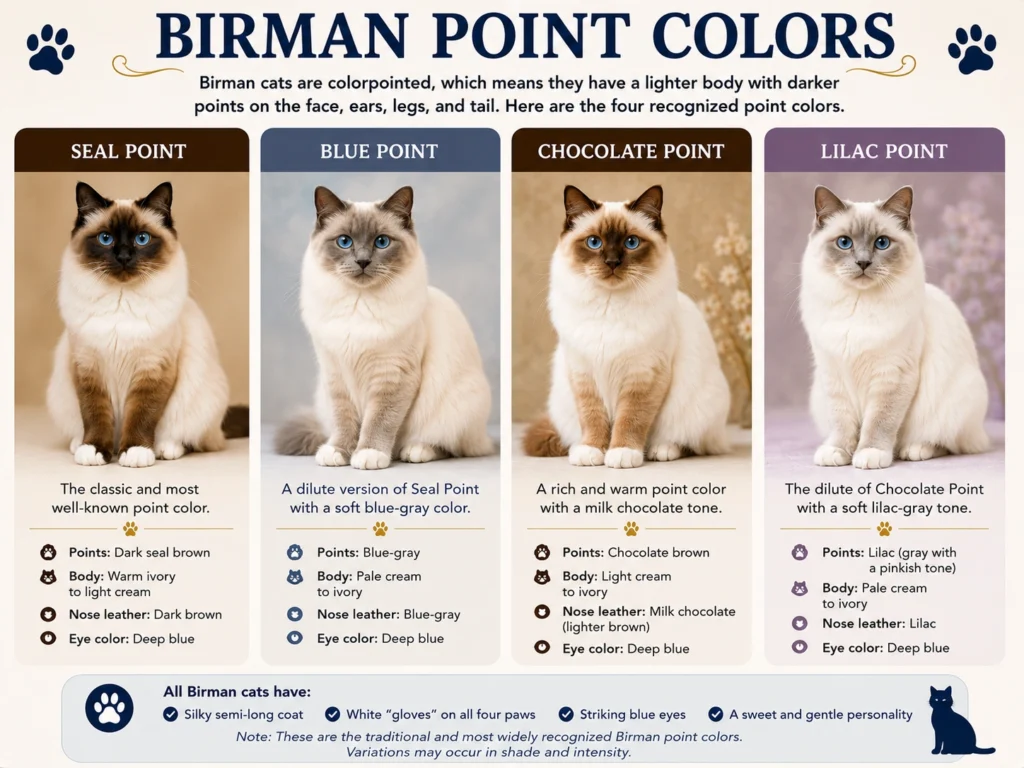
The supplied Birman color guide shows four recognised point colors.
1. Seal Point Birman Cat
The Seal point Birman cat has dark seal-brown points on the face, ears, legs, and tail.
Its body is usually a warm ivory to light cream shade, while the nose leather is dark brown. Deep blue eyes create a strong contrast with the darker face.
2. Blue Point Birman Cat
The Blue point Birman cat has softer blue-grey points instead of the dark brown coloring seen in a seal point.
Its body is pale cream to ivory, while the nose leather is blue-grey. The eyes remain deep blue.
3. Chocolate Point Birman Cat
The Chocolate point Birman cat has warm milk-chocolate brown points.
Its body is light cream to ivory, creating a gentle contrast with the warmer face, ears, legs, and tail. The supplied guide shows milk-chocolate to lighter brown nose coloring and deep blue eyes.
4. Lilac Point Birman Cat
The Lilac point Birman cat has very light lilac-grey points with a soft pinkish tone.
Its body is pale cream to ivory, while the nose leather is lilac. Like the other point colors shown, the eyes are blue.
Birman Cat Coat Patterns
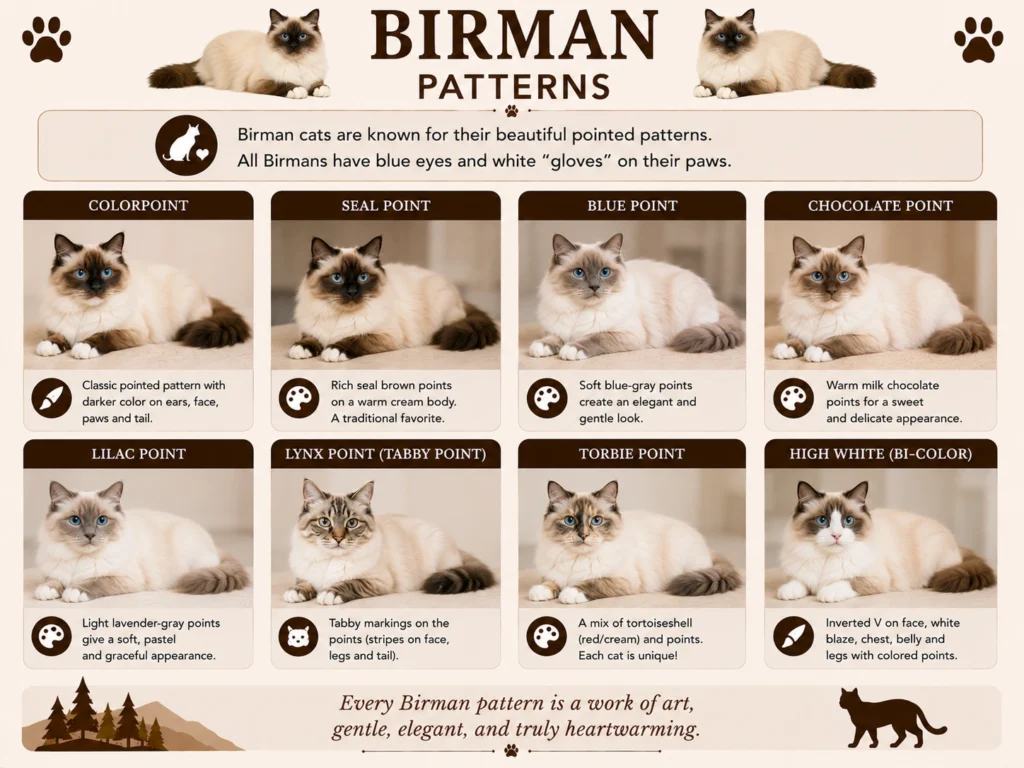
The supplied pattern guide shows several possible Birman coat appearances.
1. Colorpoint
The classic colorpoint Birman has a lighter body with darker coloring on the face, ears, paws, and tail.
2. Seal Point
Seal point combines a pale body with rich seal-brown points.
The darker mask around the face can make Birman’s blue eyes appear especially noticeable.
3. Blue Point
Blue point Birmans have soft blue-grey points with a lighter body.
This creates a cooler and more muted look than seal point.
4. Chocolate Point
Chocolate point Birmans have warm milk-chocolate points.
The coloring is generally softer and warmer than the deep brown seen in seal point cats.
5. Lilac Point
Lilac point has light lavender-grey points with a soft appearance.
It is one of the palest variations shown in the supplied Birman guide.
6. Lynx Point (Tabby Point)
A lynx point Birman has tabby-style markings within the darker point areas.
7. Tortie Point
A tortie point Birman has a mixture of colors within its point markings.
The exact placement and amount of each color can vary from one cat to another.
8. High White (Bi-Color)
The supplied guide also shows a high-white or bi-color appearance with more visible white on the face, chest, belly, and legs.
Birman Cat Personality
The Birman cat personality is generally affectionate, gentle, social, and people-oriented.
Birman cats often enjoy being close to their owners. They may follow family members from room to room, sit nearby while people work, or join in quiet household activities.
They can also be playful and curious. Interactive toys, climbing spaces, and daily attention can help keep them entertained.
Birman Cat Temperament
The Birman cat temperament is usually calm, friendly, affectionate, and easygoing.
Many Birmans enjoy attention but can also settle quietly when their family is busy. They may get along well with children and other pets when introductions are handled carefully.
Common Birman cat traits: Affectionate, gentle, social, loyal, curious, playful, and people-oriented.
Birman Cat Size, Weight and Height
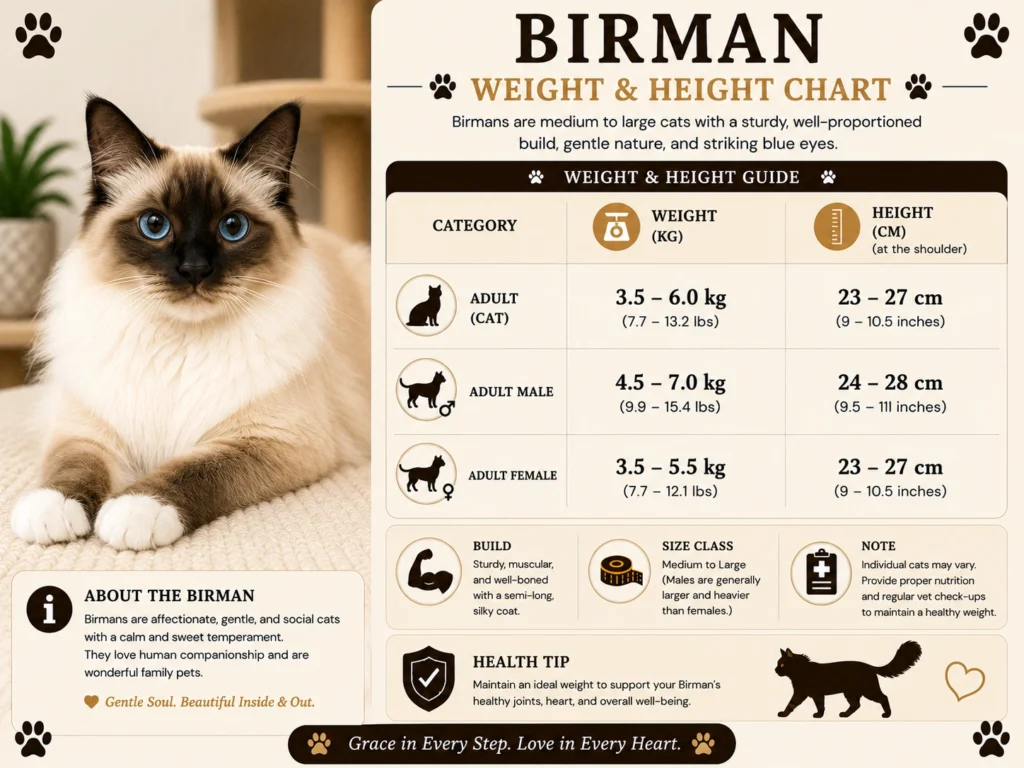
The supplied size guide describes the Birman cat as a medium to large breed with a sturdy, well-proportioned body.
Typical adult measurements shown in the guide are:
- Adult Birman: 3.5–6.0 kg and around 23–27 cm at the shoulder
- Adult male: 4.5–7.0 kg and around 24–28 cm
- Adult female: 3.5–5.5 kg and around 23–27 cm
Male Birman cats are generally larger and heavier than females.
Birman Cat Eyes
Bright blue eyes are one of the most noticeable Birman cat characteristics.
Their blue coloring contrasts beautifully with the darker facial points and lighter body.
Eye appearance can vary slightly between individual cats, but blue eyes are a defining visual feature of the Birman breed.
Birman Cat Crossbreeds and Mixes
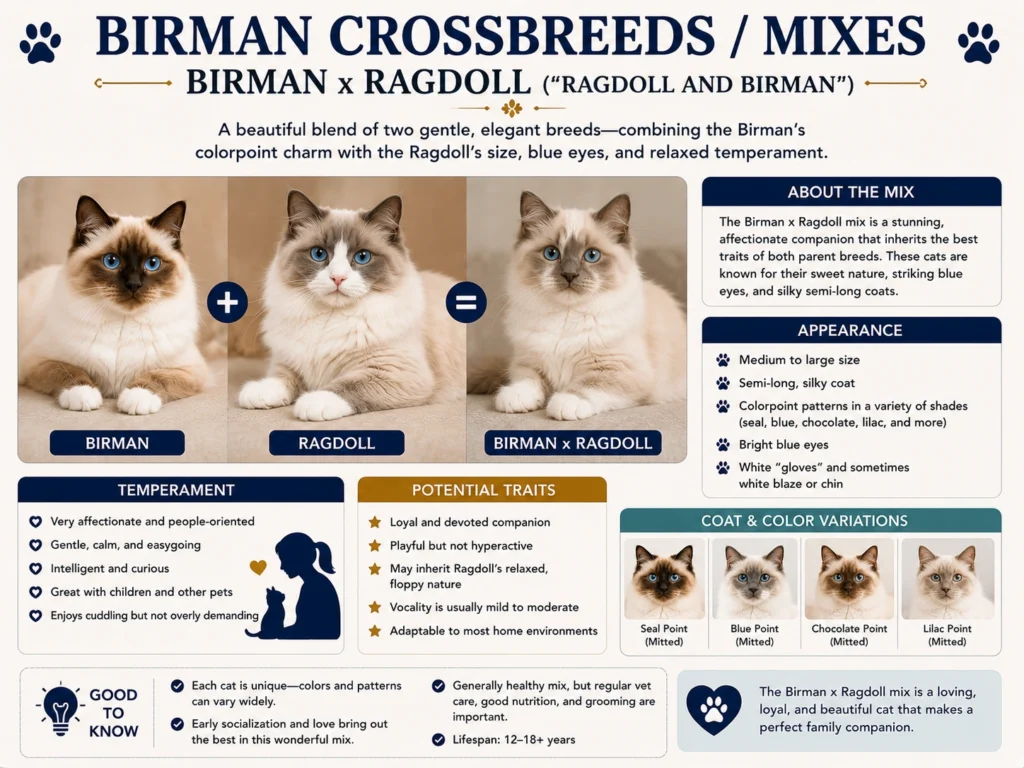
A Birman mix can inherit characteristics from both parent breeds. Coat length, color, markings, body size, personality, and grooming needs can therefore vary considerably.
The supplied crossbreed guide specifically shows a Birman × Ragdoll mix.
Birman × Ragdoll
A Birman and Ragdoll mix may combine the Birman’s colorpoint appearance with characteristics associated with the Ragdoll.
According to the supplied guide, this mix may have:
- Medium to large body size
- Semi-long, silky coat
- Blue eyes
- color point markings
- White gloves and sometimes a white blaze or chin
- An affectionate and people-oriented nature
Potential personality traits shown in the supplied guide include being loyal, devoted, playful, mildly energetic, and affectionate.
However, mixed-breed kittens do not inherit traits in fixed amounts. One kitten may look or behave more like a Birman, while another may show more Ragdoll characteristics.
Birman Cat vs Ragdoll
The Birman cat vs Ragdoll comparison is common because both breeds can have blue eyes, pointed coloring, long or semi-long coats, and affectionate personalities.
However, they are separate breeds.
When comparing a Ragdoll cat vs Birman, Ragdolls are usually larger, while Birmans have a more compact build. Birmans are known for their white paw “gloves”, while Ragdolls come in various patterns.
The Birman vs Ragdoll choice totally depends on temperament, grooming, activity, health, and your home
Birman Grooming Needs
The Birman’s medium to long silky coat needs regular grooming to keep it clean and comfortable.
Brush your Birman several times a week to remove loose hair and help prevent tangles.
Basic grooming should also include:
- Nail trimming when needed
- Regular ear checks
- Dental care
- Checking the skin and coat
- Keeping the eye area clean when necessary
Starting grooming while your Birman cat kitten is young can make the routine easier as the cat grows.
Do Birman Cats Shed?
Yes, Birman cats shed.
Their medium to long coat naturally releases loose hair. The amount may change during the year and can differ between individual cats.
Regular brushing helps collect loose fur before it reaches furniture and clothing. It also gives pet parents a chance to check the cat’s skin and coat.
Are Birman Cats Hypoallergenic?
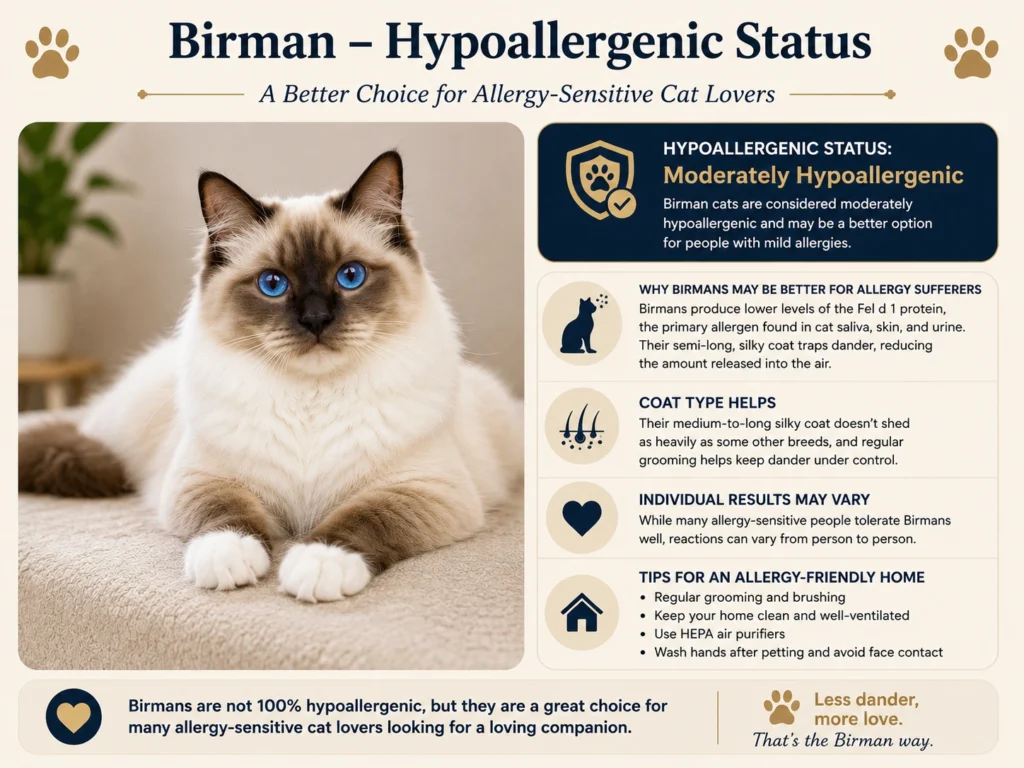
Birman cats are not completely hypoallergenic.
The supplied guide describes the breed as moderately hypoallergenic and suggests that some people with mild allergies may tolerate an individual Birman better than other cats.
However, this does not mean a Birman will be safe for every allergy sufferer.
Cat allergies are commonly linked to proteins such as Fel d 1, which are found in saliva, skin, and other secretions. These allergens can spread onto the coat when a cat grooms itself.
Individual reactions can vary greatly.
If someone in your home has cat allergies, spending time around a Birman before bringing one home can help you understand how strongly they may react.
Tips for Reducing Allergens at Home
Regular grooming, washing pet bedding, cleaning floors and furniture, using a HEPA air purifier, and keeping the bedroom cat-free may help reduce allergen exposure.
These steps can help manage allergens, but they cannot make a Birman completely hypoallergenic.
Birman Cat History and Origin
The Birman cat breed is also known as the Sacred Birman cat. The breed is surrounded by stories linking it to temple cats in Myanmar, formerly called Burma.
However, the exact early history of the breed is not fully documented. The modern Birman was developed in Europe, particularly France, where breeding programmes helped establish its distinctive appearance.
Over time, the Birman became recognised for its blue eyes, colorpoint coat, silky fur, and white paws.
Today, Birman cats are kept as companion cats in many countries and are valued for both their elegant appearance and gentle personality.
Birman Exercise and Daily Activity
Birmans enjoy short bursts of play and time to explore. Toys, scratching posts, and cat trees help keep them busy. Birman kittens need more playtime as they grow.
Birman Cat Food and Nutrition
Feed your Birman cat quality food based on its age, size, health, and activity. Birman kittens need meals that support growth, while adults need balanced food to stay healthy.
Fresh water should always be available.
Because every cat has different nutritional needs, portion sizes should be based on the individual cat rather than breed alone.
Avoid regular overfeeding. Maintaining a healthy body condition can support your Birman’s joints, mobility, and general health.
If you are unsure about the right food or portion size, ask your veterinarian for advice.
Birman Cat Health
The Birman cat is generally considered a healthy breed, but no cat is completely free from health problems.
Regular veterinary check-ups are important throughout the cat’s life.
Keep an eye on your Birman’s:
- Weight and body condition
- Teeth and gums
- Eyes and ears
- Skin and coat
- Appetite
- Drinking habits
- Litter-box habits
- Movement and activity
- Behaviour
Responsible Birman cat breeders should pay attention to the health of the cats and their kittens both.
When choosing a kitten, ask about the health history of its parents, veterinary checks, vaccinations, and any health screening carried out by the breeder.
Contact a veterinarian if you notice unexplained changes in your cat’s appetite, weight, behaviour, movement, breathing, or energy.
Birman Cat Life Expectancy
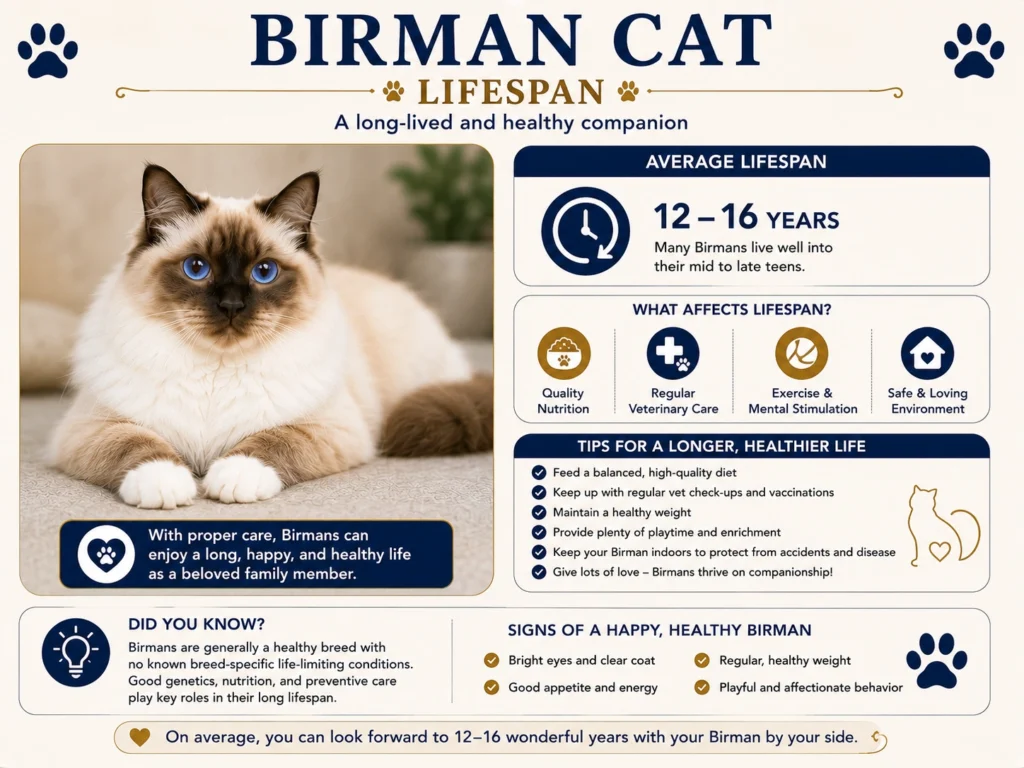
The supplied lifespan guide gives an average Birman cat life expectancy of around 12–16 years.
The life expectancy of a Birman cat is not exactly the same for every individual. Factors like-Genetics, nutrition, weight, exercise, living environment, and veterinary treatment can all influence lifespan.
Keeping a Birman indoors or providing a secure outdoor environment can also reduce exposure to traffic, fights, infectious diseases, and other outdoor dangers.
Good food, regular veterinary care, daily activity, mental stimulation, and a safe home can support a longer and healthier life.
Birman Cat Kittens
A Birman cat kitten can be playful, curious, and affectionate. Birman kittens need a safe space, toys, scratching surfaces, sleeping areas, and early socialisation.
When choosing a kitten, check its health, parents, vaccinations, veterinary records, feeding routine, socialisation, pedigree, and living conditions. If you see Birman kittens for sale, look beyond photos and price.
Breeding Birman Cats
Breeding Birman cats should always prioritise health, welfare, temperament, and responsible care.
Breeding should not simply focus on producing kittens with a particular point color.
Breeding cats should receive appropriate veterinary care and health screening. Their temperament and overall condition should also be considered.
Kittens need proper nutrition, a clean living environment, veterinary care, and early socialisation before moving to new homes.
Responsible breeding also means carefully choosing suitable homes for kittens.
Finding Birman Cat Breeders
If you are searching for Birman cat breeders, take time to research them carefully.
Ask about veterinary care, vaccination records, health screening, pedigree information, socialisation, and how the kittens are raised.
If you are choosing a Birman kitten breeder, pay attention to the living conditions as well.
Kittens should be raised in a clean, safe environment and receive regular positive interaction with people.
Avoid sellers who refuse to provide basic information about the kitten or its parents.
Buying a Birman Cat
If you are searching for a Birman cat for sale, do not rush into buying the first kitten you find.
Research the breeder or seller and ask detailed questions.
Check:
- Health records
- Vaccination information
- Parent information
- Pedigree details, if applicable
- Veterinary checks
- Kitten age
- Socialisation
- Living conditions
People searching online for Birman cats for sale or Birman kittens for sale should be especially careful with advertisements that provide very little information.
A photograph cannot confirm a kitten’s health, temperament, pedigree, or breeding conditions.
Responsible sellers should be open about where their kittens come from and how they have been raised.
Birman Cat Adoption and Rescue
Birman cat adoption is possible through shelters, rescue groups, and breed-specific organisations. Purebred Birmans are uncommon, but you may find Birman mixes. When considering a Birman cat rescue, check the cat’s health, age, personality, behaviour, and medical needs.
Birman Cat Price and Cost
The Birman cat price can vary considerably depending on the breeder, country, pedigree, age, location, availability, and veterinary care provided before the kitten goes to its new home.
The initial purchase price is only one part of the total Birman cat cost.
Pet parents should also budget for food, litter, vaccinations, vet visits, grooming, toys, scratching posts, a carrier, bedding, dental care, and emergency treatment.
Choosing a kitten based only on price can lead to problems if health and responsible breeding are overlooked.
Birman Cat Price in India
The Birman cat price in India varies by- breeder, location, pedigree, age, and availability. Always compare the reputable breeders and check health records, vaccinations, and pedigree before buying. Be cautious of unusually low prices.
Birman Care Tips
A Birman needs regular care, including coat brushing, balanced food, fresh water, and a clean litter box. Provide daily play, scratching and climbing areas, and time with the family. Regular checks of the teeth, ears, eyes, nails, coat, weight, and overall behaviour are also important.
Is the Birman Cat Right for Your Home?
The Birman cat is an affectionate, gentle, and social breed. With its blue eyes, silky coat, and white paws, it is easy to recognise. Birmans enjoy human company, playtime, and a calm environment, but need regular grooming, good nutrition, veterinary care, and daily attention.
FAQs
1. What is the personality of a Birman cat?
The Birman cat personality is considered sweet, relaxed, and people-friendly. A Birman cat temperament is playful and calm.
2. What is the life expectancy of a Birman cat?
The Birman cat life expectancy shown in the supplied guide is around 12–16 years. The actual life expectancy of a Birman cat can vary depending on genetics, nutrition, weight, exercise, veterinary care, and living environment.
3. What is the Birman cat price in India?
The Birman cat price in India can change based on the breeder, location, age and its availability. Always check the kitten’s health, vaccines, and breeder details before buying.
4. Where can I find Birman kittens for sale?
If you are looking for Birman kittens for sale, search for responsible Birman cat breeders who provide clear information about the kitten’s parents, health, vaccinations, pedigree, veterinary care, and socialisation. Avoid sellers who cannot provide basic health or background information.
5. What is the difference between a Birman and a Ragdoll?
In a Birman cat vs Ragdoll comparison, both breeds can have blue eyes, pointed coloring, affectionate personalities, and semi-long coats. Ragdolls are generally larger, while Birmans are particularly recognised for their distinctive white “gloves.” When considering Birman vs Ragdoll, also compare grooming needs, personality, size, activity level, and the individual cat.
6. Can I adopt a Birman cat instead of buying one?
Yes. Birman cat adoption may sometimes be possible through shelters, cat welfare groups, or a Birman cat rescue organisation.