
The Cornish Rex cat is a curly-coated breed known for its large ears, slender body, expressive eyes, and very soft, wavy coat. The Cornish Rex cat breed is playful, affectionate, active, and curious. These cats often enjoy being around people and staying involved in everyday activities.
Cornish Rex cats can have many coat colours and patterns, which makes their unusual curly coat even more noticeable. If you are looking for a Cornish Rex cat kitten, researching Cornish Rex cat breeders, or considering a Cornish Rex cat for sale, this Cat house guide covers the breed’s appearance, colours, patterns, personality, size, care, health, lifespan, price, and adoption.
Cornish Rex Appearance
The Cornish Rex cat is easy to spot with its slim body, long legs, large ears, and bright eyes. Its most special feature is its short, soft, curly coat, which comes in many colours and patterns.
Shop the collection


Cornish Rex Coat Colours
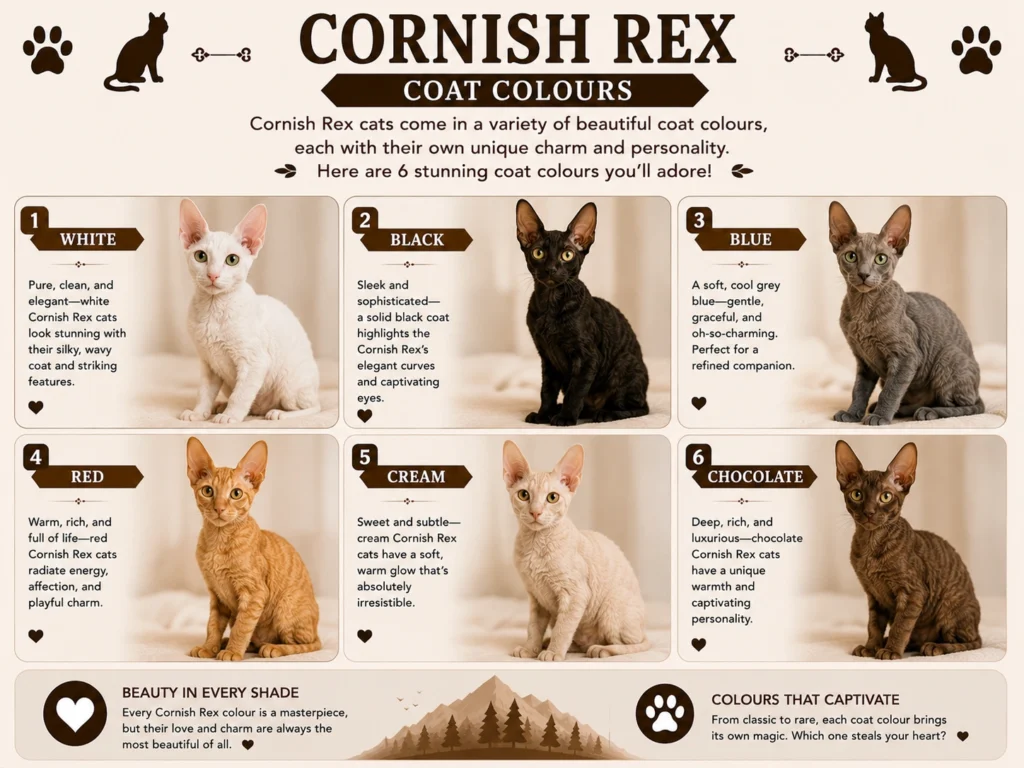
The supplied Cornish Rex guide shows six coat colours:
1. White Cornish Rex
A white Cornish Rex cat has a clean, light-coloured coat. The soft white curls can make the breed’s large ears and expressive facial features stand out clearly.
2. Black Cornish Rex
A black Cornish Rex cat has a dark, solid-looking coat. Its black colouring can highlight the waves and curves of the short fur and create a strong contrast with the eyes.
3. Blue Cornish Rex
A blue Cornish Rex has a soft, cool grey or blue-grey coat. This colour gives the cat a subtle appearance while still showing the breed’s characteristic curls.
4. Red Cornish Rex
A red Cornish Rex has a warm reddish or orange-toned coat. The colour can make the natural waves of the fur particularly noticeable.
5. Cream Cornish Rex
A cream Cornish Rex has a light and warm coat colour. It is softer in appearance than red and works beautifully with the breed’s fine curly coat.
6. Chocolate Cornish Rex
A chocolate Cornish Rex has a deep, rich brown coat. The darker shade can emphasise the texture of the curls and give the cat a distinctive appearance.
Cornish Rex Coat Patterns
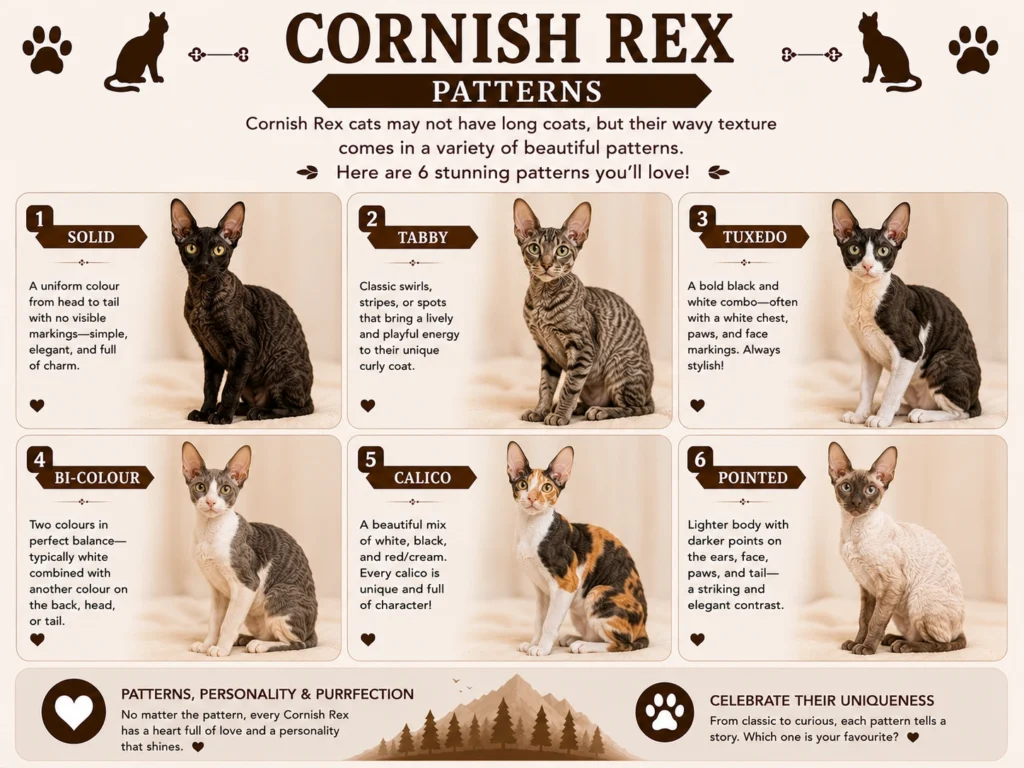
Along with different colours, Cornish Rex cats can have several coat patterns-
1. Solid
A solid Cornish Rex has one main colour across its body. There are no obvious large contrasting markings, giving the coat a simple and uniform appearance.
2. Tabby
A tabby Cornish Rex can have stripes, swirls, or other tabby markings across its coat. The markings can look especially interesting when combined with the breed’s wavy fur.
3. Tuxedo
A tuxedo Cornish Rex has a darker coat combined with contrasting white areas. White may appear on areas such as the chest, paws, or face.
4. Bi-Colour
A bi-colour Cornish Rex has two visible coat colours. One of these colours is commonly white, with the second colour appearing across areas such as the back, head, or tail.
5. Calico
A calico Cornish Rex has a combination of white, black, and red or cream colouring. The placement of these colours can differ from one cat to another.
6. Pointed
A pointed Cornish Rex has a lighter body with darker colouring on areas such as the ears, face, paws, and tail. This creates a clear contrast between the body and the darker points.
Each pattern can look different because the Cornish Rex’s curly coat changes how colours and markings appear.
Cornish Rex Cat Personality
The Cornish Rex cat is known for being playful, lively, affectionate, and curious.
Cornish Rex cats are friendly, active, and enjoy being around their owners. They love playing, climbing, jumping, and exploring. Toys, puzzle feeders, and scratching posts help keep them busy. After playtime, they often enjoy relaxing near their owners.
Cornish Rex Cat Size and Height
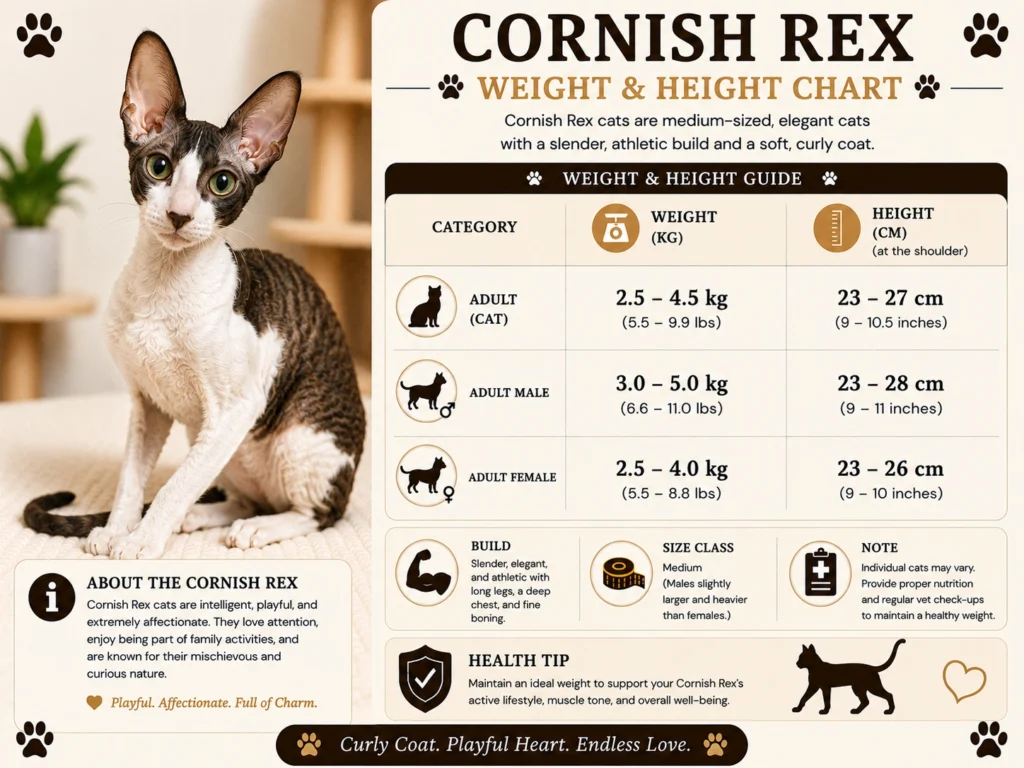
The Cornish Rex cat breed is a medium-sized cat with a slender and athletic body.
According to the supplied weight and height chart:
- Adult cat: 2.5–4.5 kg and 23–27 cm
- Adult male: 3.0–5.0 kg and 23–28 cm
- Adult female: 2.5–4.0 kg and 23–26 cm
Individual cats can be smaller or larger than these ranges. Genetics, sex, age, diet, activity, and general health can affect their final size.
The Cornish Rex has a lean and elegant build. Its long legs, fine chest, and athletic body support its active lifestyle.
Cornish Rex Crossbreeds
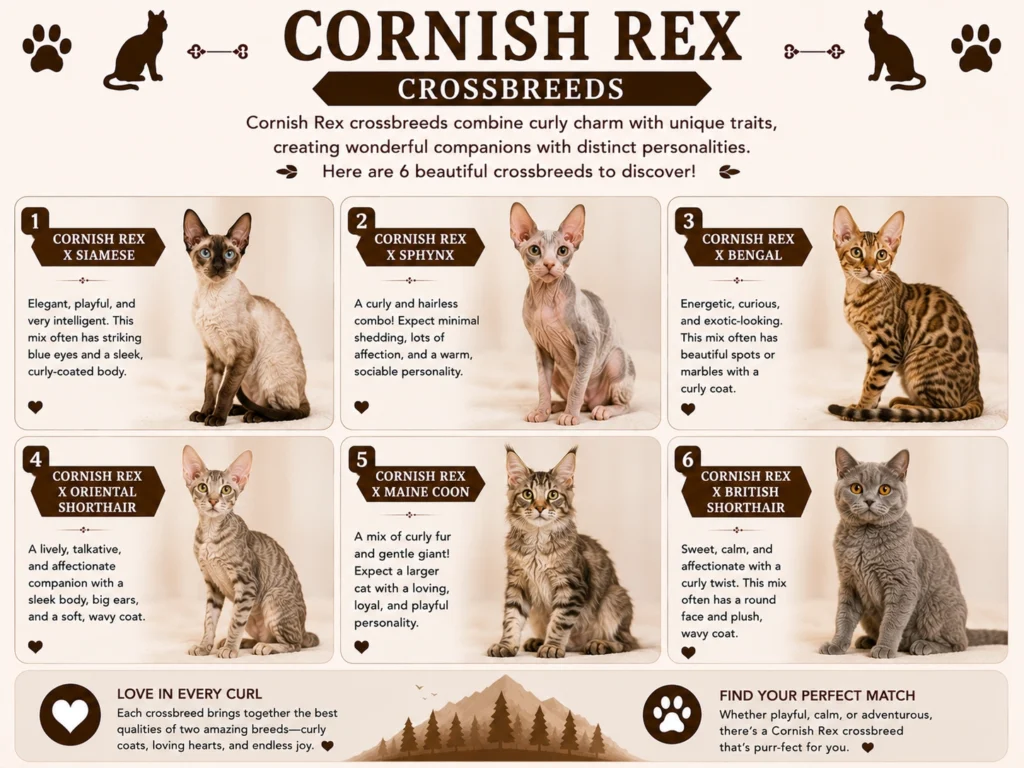
The Cornish Rex cat may also be crossed with other cat breeds. The supplied crossbreed guide shows six examples:
1. Cornish Rex × Siamese
A Cornish Rex and Siamese mix may have an elegant body and distinctive facial features. The appearance and personality can vary depending on which traits the kitten inherits.
2. Cornish Rex × Sphynx
A Cornish Rex and Sphynx mix may have a very short or minimal coat. Coat texture and the amount of hair can vary between individual kittens.
3. Cornish Rex × Bengal
A Cornish Rex and Bengal mix may combine an athletic build with bold markings. Some kittens may show spots or other Bengal-like patterns.
4. Cornish Rex × Oriental Shorthair
This mix may have a slim body, large ears, and a friendly nature. Its coat may vary based on the traits it gets from both parents.
5. Cornish Rex × Maine Coon
A Cornish Rex and Maine Coon mix can inherit traits from two very different-looking breeds. Size, coat length, curl, and personality can vary greatly between kittens.
6. Cornish Rex × British Shorthair
A Cornish Rex and British Shorthair mix have a fuller body and a softer look. Its coat, size, colour, and personality can vary based on the traits inherited from both parents.
Cornish Rex Grooming Needs
The Cornish Rex cat has a fine, curly coat that is easy to care for like-
- Light coat brushing
- Ear cleaning
- Nail care
- Teeth cleaning
- Skin and paw checks
Baths may be needed sometimes, especially if the skin becomes oily.
Cornish Rex Exercise and Daily Activity
The Cornish Rex cat has a fine coat that needs gentle care. Avoid rough brushing, as it can harm the curls. Check the ears, nails, teeth, skin, and paws regularly. Some cats may have oily skin, so bathe only when it’s needed in order to avoid dryness.
Cornish Rex History and Origin
The Cornish Rex cat breed originated in Cornwall, England. The breed began with a naturally occurring genetic mutation that produced an unusual curly coat.
The first recognised Cornish Rex kitten, Kallibunker, was born in Cornwall in 1950. His unusual wavy coat became the foundation for the development of the breed.
The Cornish Rex comes from Cornwall, where the breed began. “Rex” refers to its curly coat. It is sometimes confused with the Devon Rex, but they are separate breeds with different coat genes.
Cornish Rex Lifespan
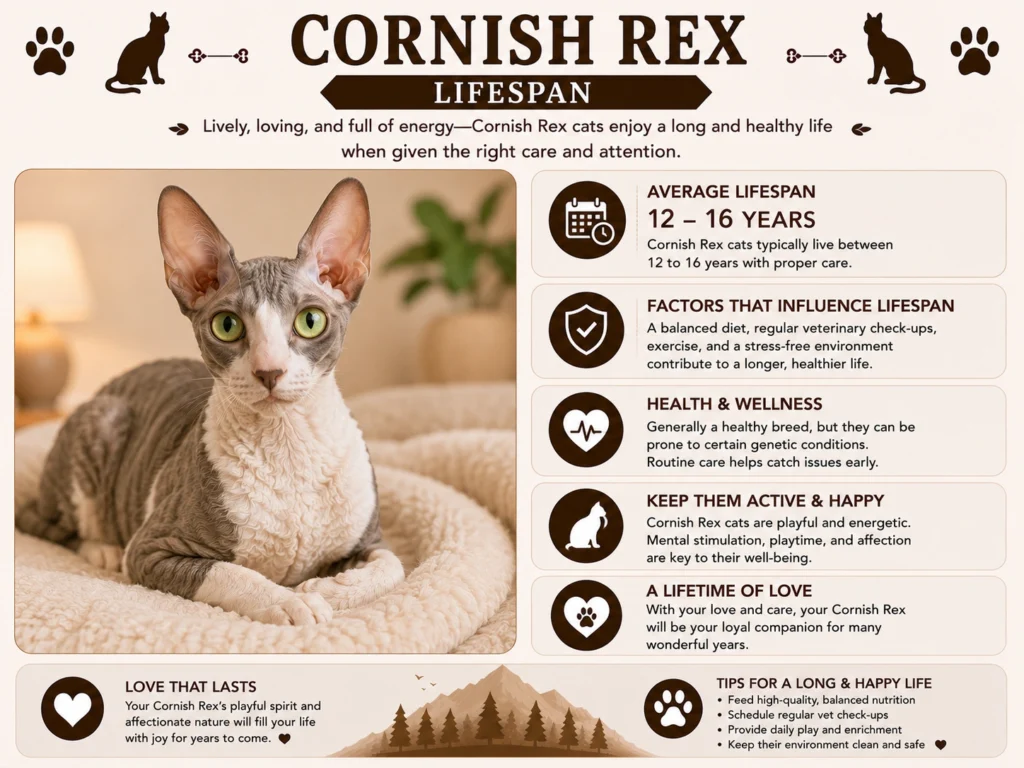
The Cornish Rex cat lifespan is generally around 12–16 years, as shown in the supplied lifespan guide.
Some cats may live longer when they receive good nutrition, regular veterinary care, exercise, attention, and a safe home environment.
Several factors can influence lifespan, including genetics, diet, healthcare, activity level, and general living conditions.
Regular veterinary check-ups can help monitor the cat’s health and identify possible problems early.
A balanced diet, fresh water, daily exercise, mental stimulation, and plenty of affection can all support a Cornish Rex throughout its life.
Are Cornish Rex Cats Hypoallergenic?
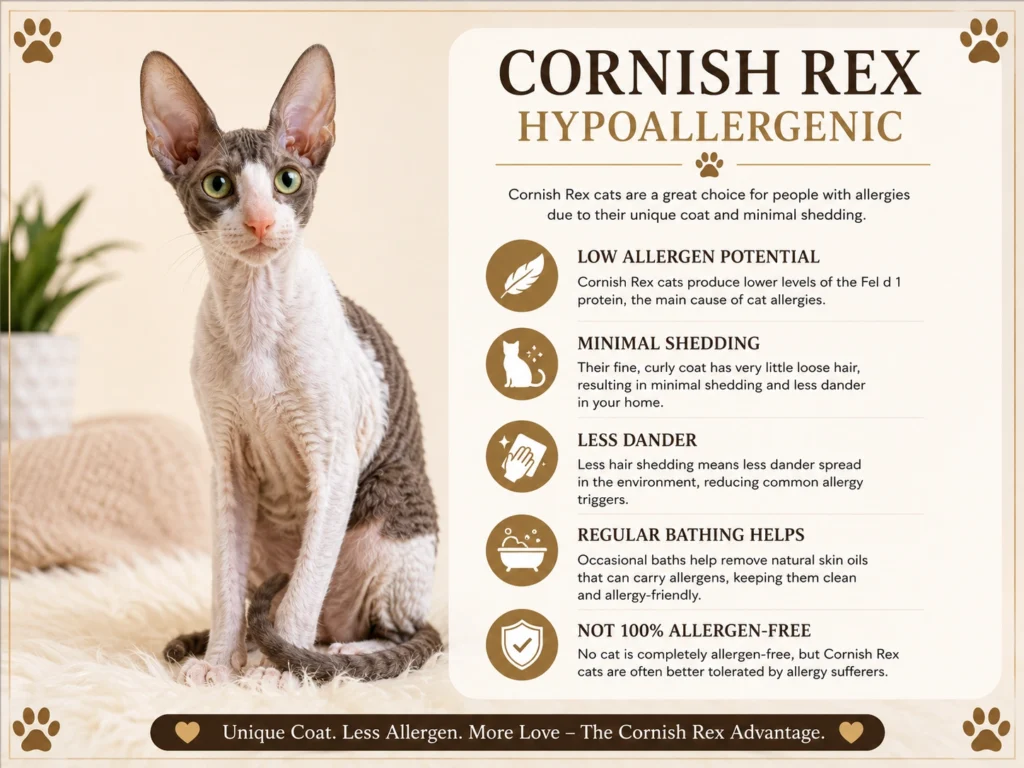
The question “are Cornish Rex cats hypoallergenic?” is common because this breed has a very short, fine coat and sheds less visibly than many other cats.
The Cornish Rex may have lower allergy potential for some people because its fine coat produces less loose hair around the home. However, the breed is not 100% hypoallergenic.
Cat allergies are not caused by fur alone. Allergens such as the Fel d 1 protein can be found in a cat’s saliva and skin secretions. When cats groom themselves, allergens can get onto their coat and spread around the home.
For this reason, someone with allergies may still react to a Cornish Rex.
Tips for Reducing Allergens
To reduce allergens, keep bedding and sleeping areas clean, vacuum often, wash your hands after handling the cat, and keep the home well aired. Cornish Rex cats are not hypoallergenic, so spend time with one before bringing it home if you have allergies.
Cornish Rex Health
The Cornish Rex cat is usually a healthy breed, but it still needs regular care. Take it for routine vet checks and keep an eye on its skin, coat, weight, and teeth. If you notice redness, hair loss, or other changes, visit the vet immediately.
If you are buying a Cornish Rex cat kitten, ask the breeder about the health of both parents and any health screening carried out before breeding.
Cornish Rex Cat Food and Nutrition
Proper food helps keep a Cornish Rex cat active and healthy. Choose food that suits its age, size, and activity level, and always keep fresh water nearby. Give suitable portions and ask a vet if you are unsure about feeding amounts.
Cornish Rex Grooming
The short, curly coat is one of the most recognisable features of the Cornish Rex cat breed.
The Cornish Rex cat has a fine coat that needs gentle care. Avoid rough brushing, as it can harm the curls. Check the ears, nails, teeth, skin, and paws regularly. Some cats may have oily skin, so bathe only when needed to avoid dryness.
Cornish Rex Exercise and Mental Stimulation
The Cornish Rex loves activity and needs opportunities to play every day.
Running, climbing, jumping, and chasing toys can help keep the cat physically active.
Interactive toys, treat games, scratching boards, and climbing spots can keep a Cornish Rex cat happy and engaged. Try different toys now and then, and give it safe areas to climb and explore.
Cornish Rex and Devon Rex Cats
The Cornish Rex and Devon Rex cats share a few features, but are two different breeds. Both have curly coats and large ears. The Cornish Rex is known for its slim shape and soft, fine coat, while the Devon Rex has a different body shape and coat.
Breeding Cornish Rex Cats
Breeding Cornish Rex cats should focus on healthy parents and well-cared-for kittens.
If you are searching for Cornish Rex cat breeders, check how the cats and kittens are raised. Ask about veterinary care, vaccinations, the health of the parents, and relevant health screening.
A responsible breeder should provide clear information and answer questions about the kitten’s background.
The breeder should also care about where their kittens are going rather than simply trying to make a quick sale.
Cornish Rex Cat Kittens
A Cornish Rex cat kitten is usually active, curious, playful, and eager to explore.
Kittens need daily play and a safe environment where they can climb, scratch, rest, and investigate their surroundings.
A healthy kitten should appear alert and appropriately active. Its eyes and nose should look clean, while the skin and coat should appear healthy.
Early socialisation is also important. Positive experiences with people, handling, grooming, carriers, and normal household activities can help kittens become comfortable adults.
If you are looking for a Cornish Rex cat for sale, do not choose a kitten based only on its photograph, coat colour, or advertised price.
Ask about its parents, health, vaccinations, socialisation, and living conditions before making a decision.
Cornish Rex Cat Adoption and Rescue
You can find Cornish Rex cats for adoption through shelters, rescue groups, and breed-specific organisations, not just breeders. Since this breed is less common, finding one may take time. Before adopting, ask about the cat’s health, age, personality, and experience with children or other pets.
Cornish Rex Cat Price and Cost
The Cornish Rex cat price can vary depending on the breeder, location, pedigree, age, availability, and veterinary care provided.
If you are checking the Cornish Rex cat cost, remember that the initial price is only part of the expense. You should also plan for food, litter, vet visits, vaccines, toys, grooming, and other daily needs.
A cheaper kitten is not always the best choice. Good health, responsible breeding, and proper care matter more.
Buying a Cornish Rex Cat
If you are searching for a Cornish Rex cat for sale, choose a breeder carefully. Look beyond photos and price, and ask about the kitten’s living conditions, parents, socialisation, vaccinations, health checks, and vet history. A responsible breeder should provide clear answers.
What to Check Before Buying a Cornish Rex Cat Kitten
If you find Cornish Rex cats for sale, check their health, vet records, parents, health tests, living conditions, and socialisation. The kitten should look active and healthy and be raised in a clean, safe place. Ask how it interacts with people and daily activities, and avoid paying until you have enough information about the kitten and seller.
Finding Cornish Rex Cats for Sale
People looking for Cornish Rex cats for sale should focus on finding a responsible breeder rather than simply choosing the closest or cheapest seller.
Check the breeder carefully and ask for clear information about the kitten’s health and parents.
If possible, learn about the environment in which the kitten has been raised.
Responsible Cornish Rex cat breeders should prioritise the health and welfare of their cats.
Cornish Rex Cat Adoption
If buying is not your preferred option, consider Cornish Rex cats for adoption.
Check local shelters, cat rescue organisations, and breed-specific rescue groups. Both adult cats and, occasionally, kittens may need new homes.
Before adopting, learn about the cat’s health, behaviour, history, and care requirements.
An adult cat can be a particularly good choice because its established personality may make it easier to understand whether it will suit your household.
Cornish Rex Care Tips
Daily love and care can help your Cornish Rex cat stay happy and active. Give it good food, fresh water, playtime, scratching posts, places to climb, and a warm spot to rest. Check its ears, teeth, nails, skin, and coat often, keep the litter tray clean, and visit the vet for regular check-ups.
Is the Cornish Rex Right for Your Home?
The Cornish Rex cat is a good match for people who enjoy an active and loving pet. It likes playing, climbing, and being around people. Keep it warm indoors and teach children to be gentle when handling it.
FAQs
1. Are Cornish Rex cats hypoallergenic?
Cornish Rex cats are not fully hypoallergenic. Their shorts may leave less hair around, but they can still catch allergies.
2. How long do Cornish Rex cats live?
A Cornish Rex cat lifespan is usually around 12–16 years. Good food, regular vet care, and daily activity can help them stay healthy.
3. How much does a Cornish Rex cat cost?
The Cornish Rex cat price varies depending on location, breeder, pedigree, age, availability, and health care. When calculating the total Cornish Rex cat cost, also consider food, litter, veterinary care, toys, grooming, and other ongoing expenses.
4. Where can I find Cornish Rex cats for sale?
If you are looking for Cornish Rex cats for sale, choose a trusted breeder who can share details about the kitten’s parents, health, vaccines, vet care, and living space.
5. Can I find Cornish Rex cats for adoption?
Yes. Cornish Rex cats for adoption may occasionally be available through shelters, cat rescue organisations, or breed-specific rescues. Availability may be limited because the breed is relatively uncommon.
6. Are Devon Rex and Cornish Rex cats the same?
No. Devon Rex and Cornish Rex cats are separate breeds. Both have unusual curly coats, but the genetic mutations responsible for their coats are different. Their coat texture and overall appearance also differ.