
The Balinese cat is a slim and graceful breed with bright blue eyes and a soft, silky coat. It has large ears and darker markings on the face, ears, legs, and tail. This pointed colouring gives the Balinese a look similar to the Siamese cat.
Balinese cats are known for being close to their families. Many follow their owners from room to room and enjoy being part of daily life. They are also playful and curious. This means they need attention, toys, exercise, and things to explore.
The breed is sometimes described as a balinese long haired siamese cat because of its close link with the Siamese.
Shop the collection


If you are thinking about bringing one home, this Cat House guide explains the balinese cat breed, personality, temperament and more.
History of the Balinese Cat Breed
The history of the balinese cat breed is closely connected to the Siamese.
Long-haired kittens sometimes appeared in Siamese litters. These kittens had the same slim body, pointed coat, and blue eyes as Siamese cats. The main difference was their longer fur.
At first, breeders did not focus on these kittens. Later, some people began to appreciate their soft coats and graceful appearance. Breeders then started developing them as a separate type.
The name “Balinese” does not mean the breed came from Bali. The name was chosen because the cats moved in a graceful way that reminded breeders of Balinese dancers.
Today, the Balinese still share many physical and personality traits with the Siamese. This explains why people sometimes search for terms such as balinese long haired siamese cat.
Even so, modern Balinese cats have their own breed identity and standards.
Balinese Cat Characteristics and Appearance
The balinese cat characteristics are easy to recognise once you know what to look for.
The breed has a long, slim, and athletic body. It should look graceful rather than heavy. The legs are long and fine, while the paws are neat and balanced.
The head has a wedge-like shape. Large ears continue the smooth lines of the face. One of the most striking features is the cat’s bright blue eyes.
The tail is long and narrow. It often carries longer, flowing hair, which gives it an elegant plume.
The Balinese may look delicate, but the body should still have good muscle tone.
Balinese Cat Size Weight and Height
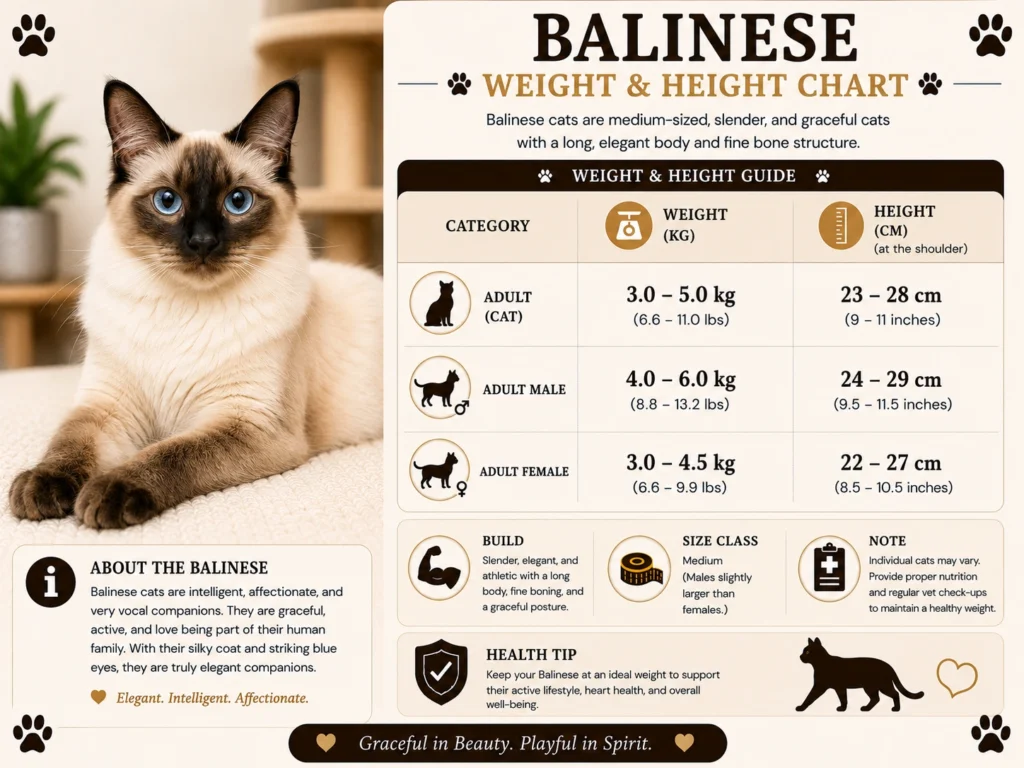
Balinese Cat Size Weight and Height
The Balinese is a medium-sized cat.
According to the supplied breed information, an adult Balinese usually weighs around 3 to 5 kg and stands about 23 to 28 cm at the shoulder.
Adult males are often larger. They may weigh around 4 to 6 kg and stand about 24 to 29 cm tall.
Adult females are usually lighter. They often weigh around 3 to 4.5 kg and stand about 22 to 27 cm tall.
These figures are only a guide.
Genetics, food, activity, age, and general health can all affect the final size of a cat.
Balinese Cat Long Hair and Coat
The balinese cat long hair is one of the features that makes this breed stand out.
A long hair balinese cat does not usually have the thick double coat seen in some other long-haired breeds.
Instead, the hair is fine, soft, and silky. It often lies close to the body.
The fur can become longer around the tail. This creates the elegant plume that many people associate with the breed.
Because the coat is not very dense, grooming is usually easier than it is with some other long-haired cats.
The Balinese coat is also colorpointed.
Balinese Cat Colors
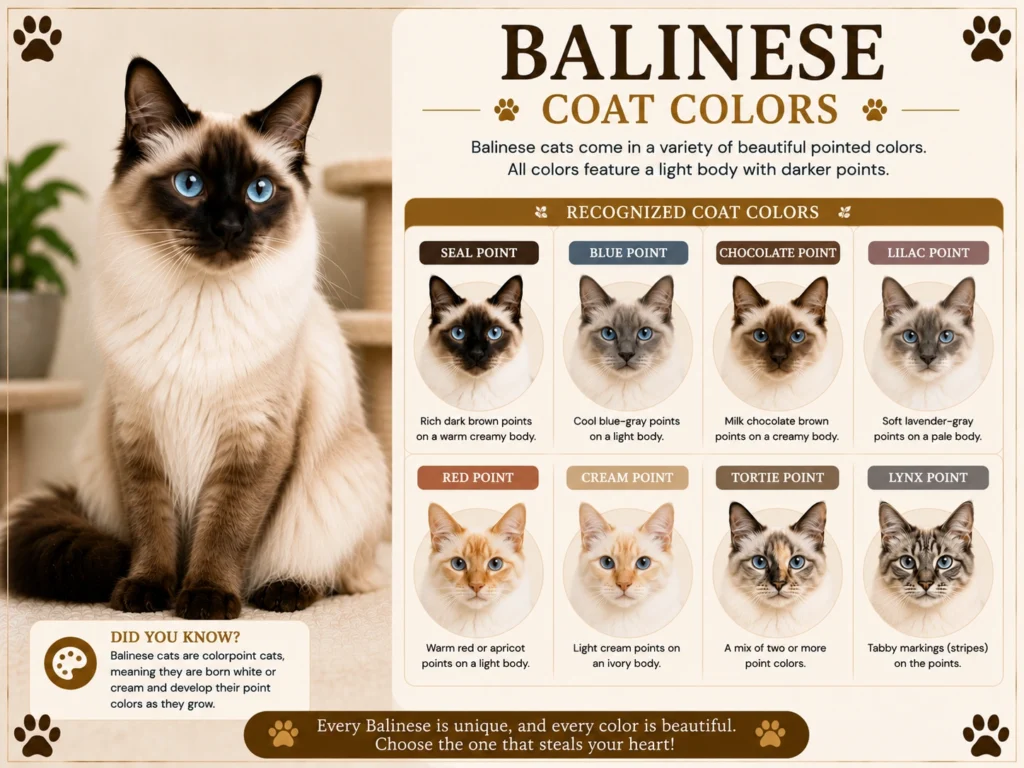
There are several attractive balinese cat colors
Seal Point Balinese Cat
The seal point balinese cat has deep brown points over a warm, light-colored body.
The face, ears, legs, and tail appear much darker than the rest of the coat.
Blue Point Balinese Cat
A blue point balinese cat has cool blue-grey points.
The body is lighter and softer in tone. This gives the cat a gentle and elegant appearance.
Chocolate Point Balinese Cat
A chocolate point balinese cat has warm, milk-chocolate points.
Its body is usually pale cream.
Lilac Point Balinese Cat
The lilac point balinese cat has pale lavender-grey points.
Its body remains very light.
Flame Point Balinese Cat
The flame point balinese cat has warm red, orange, or apricot-colored points.
The supplied information describes red point coloring as warm red or apricot points over a lighter body.
Cream Point Balinese Cat
Cream point Balinese cats have very pale warm-colored points.
Their ears, face, legs, and tail may show light cream shades over an ivory body.
Lynx Point Balinese Cat
A lynx point balinese cat has visible tabby-style stripes on its darker areas.
These markings may appear across the face, legs, and tail.
Tortie Point Balinese Cat
Tortie point cats have more than one color mixed across their points.
The face, ears, legs, and tail may show different patches or blends of color.
Black Balinese Cat
People often search for a black balinese cat.
However, a fully solid black coat is not the classic Balinese colorpoint appearance shown in the supplied breed information.
A seal point Balinese may have very dark brown points. Under some lighting, those areas can look almost black.
Balinese Cat Patterns
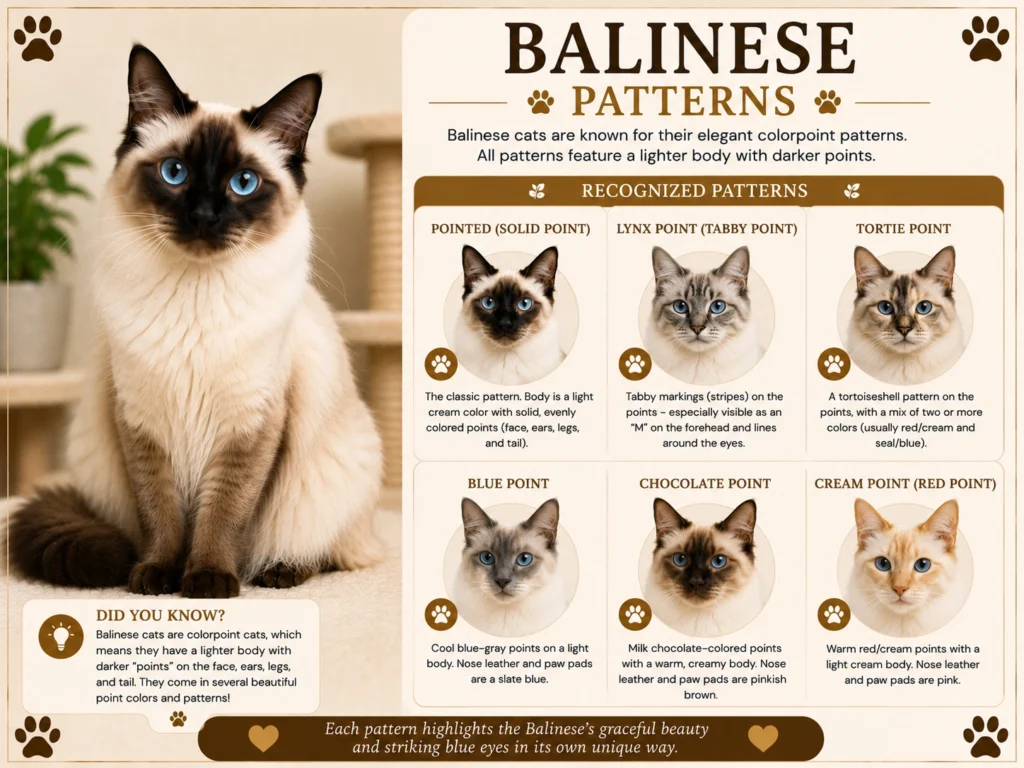
Balinese cats can also show different point patterns.
The classic pattern is the solid point. The body stays light, while the face, ears, legs, and tail are darker.
Pointed (Solid Point): The classic pattern, with a light cream body and darker, even-colored areas on the face, ears, legs, and tail.
Lynx Point (Tabby Point): The darker areas have soft tabby stripes, with an “M” shape on the forehead and lines around the eyes.
Tortie Point: The points have a mix of two or more colors, often red or cream mixed with seal or blue.
Blue Point: The cat has cool blue-grey points with a pale body. The nose and paw pads are usually slate blue.
Chocolate Point: The points are a warm milk-chocolate shade, while the body is light and creamy. The nose and paw pads may have a soft pinkish-brown colour.
Cream Point (Red Point): The points range from warm red to creamy shades, with a light body and pink nose and paw pads.
Balinese Cat Personality
The balinese cat personality is one of the main reasons people love this breed.
Balinese cats are usually affectionate, smart, active, and social.
They often become very attached to their families. Many like to follow people around the house.
A Balinese may sit beside you while you work, follow you into another room, or watch everything that is happening from a nearby perch.
These cats are also intelligent.
They can become bored if they have nothing to do for long periods.
Puzzle toys, interactive games, scratching posts, climbing furniture, and play sessions can help keep their minds active.
The Balinese can also be quite vocal.
Because of its Siamese background, it may use different sounds to get attention or respond to its family.
Every cat is still an individual. Some Balinese may be more talkative or active than others.
Balinese Cat Temperament
The typical balinese cat temperament is friendly and people-focused.
Many Balinese enjoy attention and prefer being involved in family life.
They can be playful even as adults. A Balinese may chase a wand toy, climb a tall cat tree, explore boxes, or watch birds through a window.
They may also get along with children when treated gently.
Always teach children how to handle cats with care. Do not allow rough play or unwanted carrying.
Balinese cats may also live with other pets. Introductions should be slow and calm.
Even a social cat needs time to adjust.
It is also important to provide quiet resting places. A Balinese may love attention but still needs somewhere peaceful to sleep.
Exercise and Mental Stimulation
Balinese cats are active and clever, so they need regular play. A few short play sessions each day are important for them.
A strong cat tree is especially useful.
It gives the cat space to climb, stretch, watch the room, and rest.
You can also rotate toys.
Instead of leaving every toy out all the time, put some away. Bring them back a few days later. This can make them feel interesting again.
Training can also be useful.
Simple activities such as following a target or finding hidden treats can provide mental exercise.
Balinese Cat Lifespan
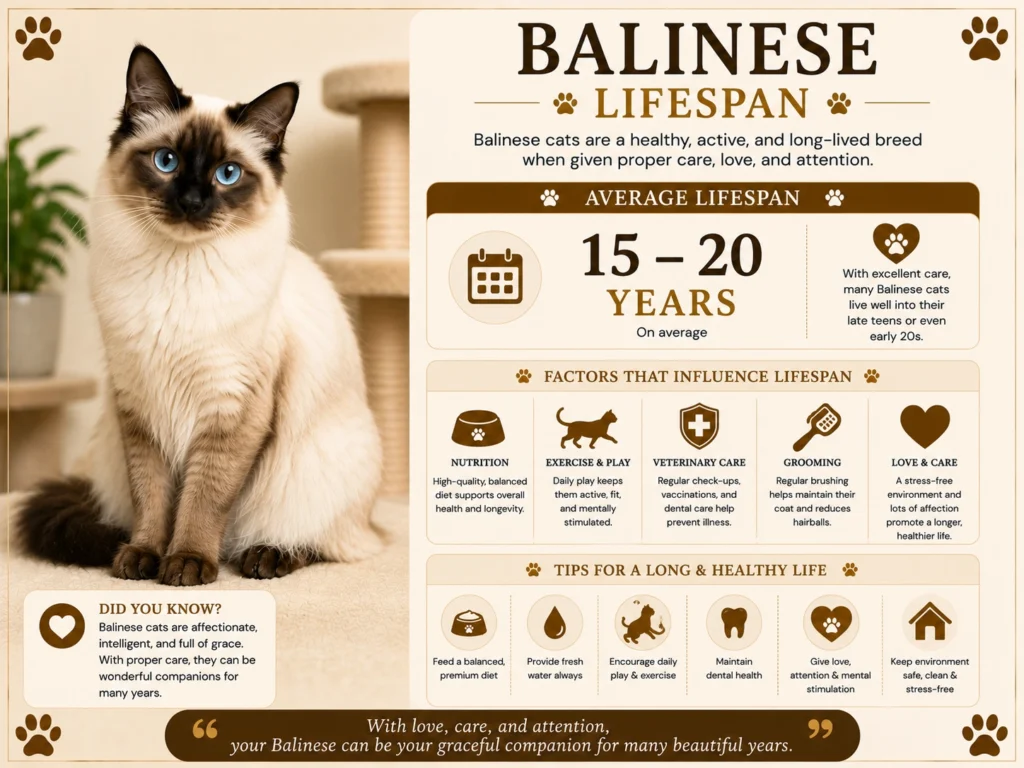
The supplied breed information gives an average balinese cat lifespan of around 15 to 20 years.
Some cats may live into their late teens or early twenties.
However, lifespan can vary.
Genetics, food, activity, dental health, veterinary care, grooming, and the home environment can all affect long-term health.
Routine vet visits are important.
They can help find changes before they become more serious.
Balinese Cat Grooming and Care
A Balinese has longer hair, but its coat is usually easy to manage.
Brush the coat two or three times each week.
Gentle brushing helps remove loose hair and prevents small tangles from forming.
Pay extra attention to the tail and any areas where the fur feels longer.
You should also check the ears and nails.
Dental care is important too. Ask your vet about a suitable dental routine.
Keep the litter box clean and place it in a quiet, easy-to-reach area.
Your cat should also have clean water, safe resting areas, scratching surfaces, and opportunities to play.
Is the Balinese Cat Hypoallergenic?
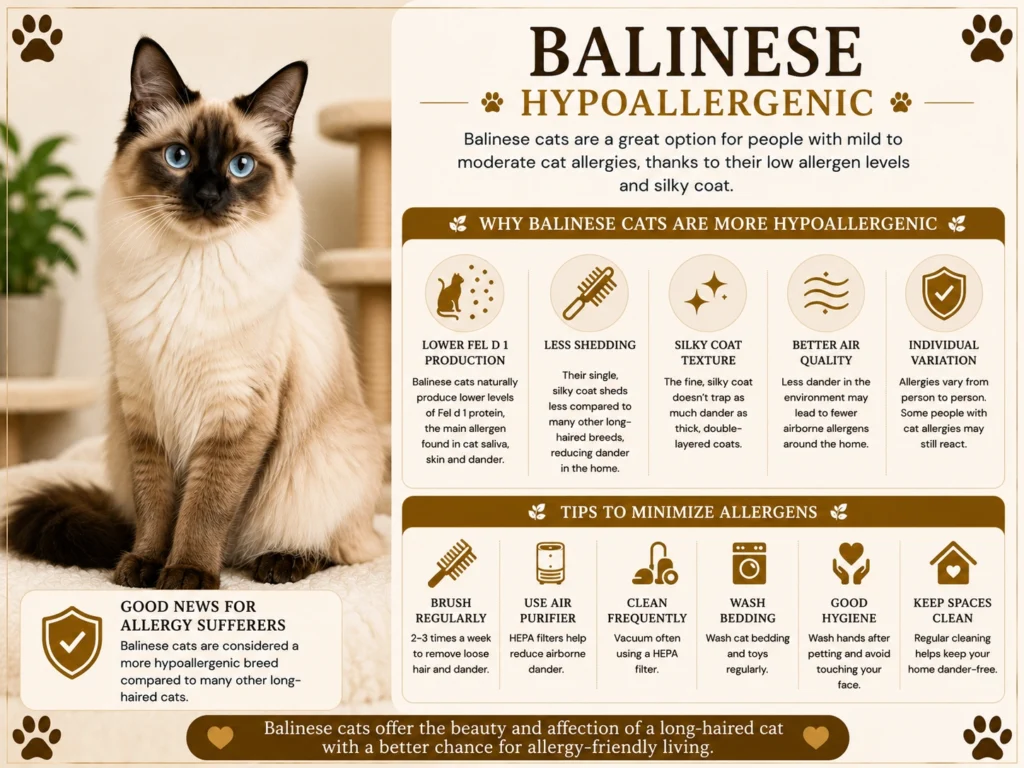
The balinese cat hypoallergenic question is common.
The Balinese is sometimes described as a better choice for some people with cat allergies. However, no cat can be guaranteed to be completely hypoallergenic.
Cat allergies are linked to proteins such as Fel d 1.
These allergens are not found only in fur. They can also be connected with saliva and other secretions.
The supplied guide describes the Balinese as a possible option for some people with mild or moderate allergies. It also notes that reactions can vary between individual people and cats.
If you are considering a balinese cat for allergies, spend time with the individual cat before bringing it home.
This can help you understand how your body reacts.
Do Balinese Cats Shed?
Yes, Balinese cats shed.
However, people searching for balinese cat shed information should know that the breed’s coat is fine and not extremely dense.
Regular brushing can remove loose hair before it spreads around the home.
Balinese Cat Health
The balinese cat breed can live a long life with suitable care.
However, no cat breed is free from health risks.
Because the Balinese are closely linked with the Siamese, inherited problems may appear in some breeding lines.
This does not mean every Balinese will become ill.
When choosing a kitten, ask the breeder about the health history of both parents.
Routine check-ups remain important after the kitten comes home.
Watch for lasting changes in appetite, weight, thirst, movement, breathing, litter habits, or behaviour.
Contact a veterinarian if anything seems unusual.
Balinese Cat Diet
Good food supports your Balinese cat’s coat, muscles, activity, and general health.
Choose complete cat food designed for the correct life stage.
Kittens need food made for growth. Adults need food that supports healthy body condition. Older cats may have different needs.
Portion size should match your cat’s weight and activity level.
Even an active Balinese can gain excess weight if he eats too much.
Treats should remain a small part of the daily diet.
Fresh drinking water should always be available.
Balinese Kittens
Balinese kittens are often playful, curious, and full of energy.
They may climb, chase toys, explore furniture, and follow family members throughout the home.
Before bringing your kitten home, make sure the space is safe. Keep wires, medicines, cleaning products, harmful plants, and small objects out of reach.
Have the basics ready, including food and water bowls, a litter tray, kitten food, a scratching post, toys, a bed, grooming items, and a secure carrier.
Early socialisation also matters.
Introduce your kitten to handling, grooming, household sounds, people, and other pets slowly.
Balinese Cat Breeders
Take your time when choosing balinese cat breeders.
A responsible balinese breeder should answer questions about the kittens and their parents.
Ask about health records, vaccinations, veterinary checks, pedigree, registration, socialisation, and the health history of the parents.
Health and welfare should always matter more than a rare color or low price.
Balinese Cat for Sale
You may see many results when searching for a balinese cat for sale or balinese kittens for sale.
Check each listing carefully.
If pedigree is important, ask for registration documents.
Look at the kitten’s general condition too.
A healthy kitten should appear alert and responsive. Its coat should look clean, and its eyes and nose should not show obvious discharge.
Ask for veterinary records where available.
Never buy a balinese cat just because the price is lower than other listings.
Responsible breeding and good health are more important.
Balinese Cat Price and Cost
The balinese cat price can vary widely.
Location, breeder, pedigree, age, registration, point color, health care, and availability can all affect the price.
There is therefore no single balinese cat cost that applies everywhere.
The balinese kitten price and balinese kitten cost can also differ between breeders.
You will also need to pay for food, litter, toys, grooming items, vaccinations, vet visits, dental care, parasite prevention, and possible emergency treatment.
Choose a kitten based on health and responsible breeding rather than price alone.
Balinese Cat Adoption
Balinese cat adoption can be another way to welcome this breed into your home.
Pedigree Balinese cats may be harder to find in shelters than common domestic cats.
Still, it is worth checking reputable shelters, rescue groups, breed rescues, and trusted rehoming organisations.
Adult balinese cats for adoption may sometimes need new homes because their owner’s circumstances have changed.
Balinese kittens for adoption can be less common, so you may need to wait.
Before adopting, ask about the cat’s health, age, personality, grooming needs, and previous home.
Balinese Cat Crossbreeds and Mixes
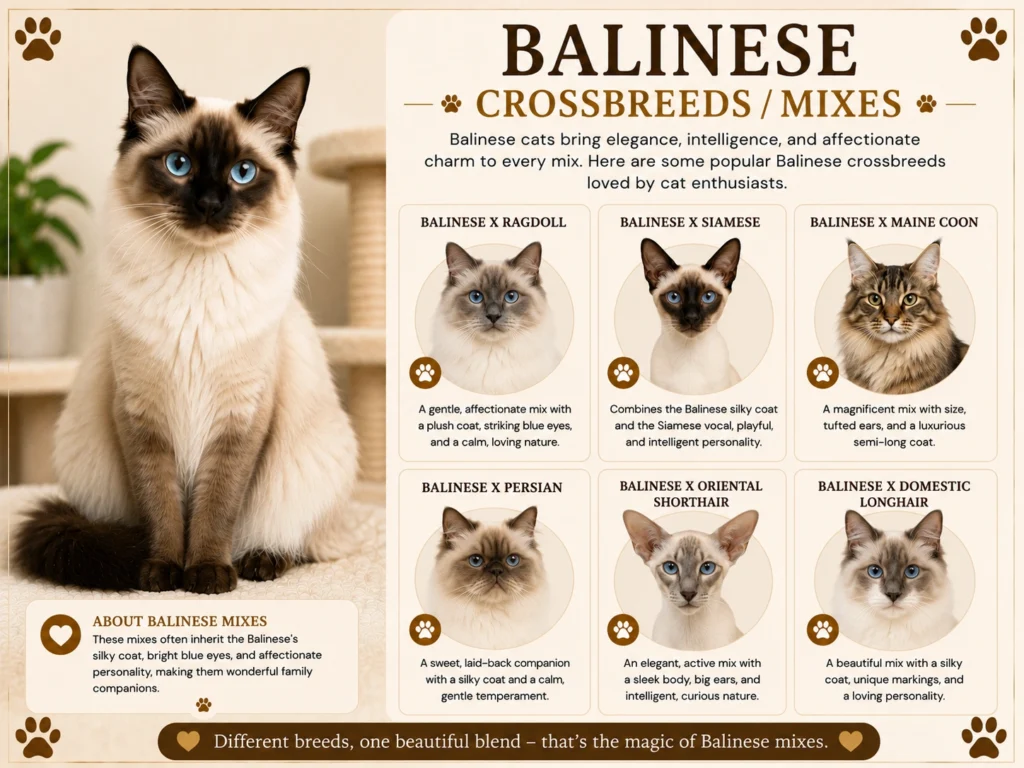
Balinese mixes can inherit different traits from each parent.
- Balinese × Ragdoll -may have a soft, longer coat and a mix of playful and relaxed traits.
- Balinese × Siamese –may have blue eyes, a slim body, pointed coloring, and a social personality.
- Balinese × Maine Coon– may grow larger and develop a fuller coat or bushier tail.
- Balinese × Persian- may inherit longer fur and could need more grooming.
- Balinese × Oriental Shorthair -may have a slim build, large ears, and an active nature.
- Balinese × Domestic Longhair- can vary greatly in coat, size, eye color, and personality.
Mixed-breed kittens do not always inherit predictable features. Each cat should be treated as an individual.
Is the Balinese Cat Right for You?
A Balinese can be a great choice if you want an active and affectionate companion.
These cats usually enjoy attention and family interaction.
They need play, climbing areas, mental stimulation, regular grooming, and time with their people.
The breed may not be ideal for someone who wants a very independent cat that spends most of the day alone.
However, for a home that can provide attention and enrichment, the Balinese can become a loving and entertaining family companion.
FAQs
1. What is the Balinese cat personality like?
The balinese cat personality is usually affectionate, playful, intelligent, and social. Many Balinese cats like staying close to their family and following people around the home. They also enjoy games, climbing, and mental challenges.
2. Is the Balinese cat hypoallergenic?
The balinese cat hypoallergenic label does not mean the breed is allergy-free. Some people may react less strongly to an individual Balinese, but reactions vary. Anyone searching for a balinese hypoallergenic cat should spend time with the cat before making a decision.
3. Does a Balinese cat shed?
Yes. A balinese cat does shed, although its coat is fine and less dense than the fur of many other long-haired breeds. Regular brushing can remove loose hair and keep the coat smooth.
4. What are the main Balinese cat colors?
Common balinese cat colors include seal point, blue point, chocolate point, lilac point, red or flame point, cream point, tortie point, and lynx point. A solid black balinese cat is not the classic colorpoint appearance of the breed.
5. How much does a Balinese cat cost?
The balinese cat price varies according to location, pedigree, breeder, registration, age, health care, and availability. The balinese kitten price can therefore be very different from one breeder to another. Health and responsible breeding should matter more than finding the cheapest kitten.
6. Where can I find Balinese cats for sale or adoption?
For Balinese kittens for sale, choose breeders who are responsible and are ready to provide health and pedigree details. For Balinese cat adoption, you can check- trusted shelters, rescues, and rehoming groups.